
The Hand Knows Before the Mind Does
Why gesture-controlled instruments change the performance experience. A foundational piece on IC Alchemy's core belief: when the instrument disappears into the body, the music emerges.
HARDWAREMUDRASSYNTH
4/30/20264 min read
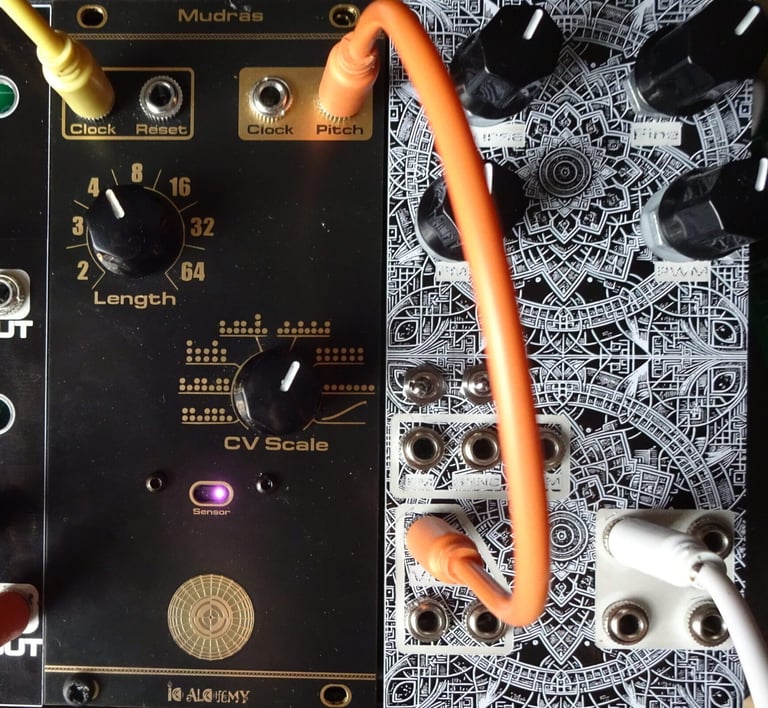
Anyone who has ever gotten completely lost in the moment while improvising knows the feeling of the music "being played for you. The music suddenly becomes effortless and your hands begin to move on their own. Before you think it. Before any screen reflects your intention back at you. Before your finger touches a key or your eye reads a menu. The hand knows what the music wants, the music is playing you.
This is not mysticism, and if you've never experienced it we likely sound crazy, but once you've "felt the spirit" you will be hooked. We want as many people as possible to experience this magic, and it is the reason we build gesture-controlled instruments.
The Cognitive Cost of Screens
Every time you look at a screen to make music, your attention splits. Some of it stays with the sound; some of it travels to the display in front of you. The instrument demands your eyes. It demands that you translate intention into menu navigation, that you wait for visual feedback, that you interrupt the flow from impulse to note.
This is not a small thing. Neuroscientists who study performance have a term for the state where thought and action fuse: flow. In flow, the performer and the instrument disappear into each other. The barrier between intention and execution vanishes. You don't think about pressing a key — your hand already knows where it is.
Modern synthesizers and sequencers built on screens and step grids interrupt that state. They force you to look away from the moment. They require you to plan notation before you can hear it. They make you a programmer, not a player.
We looked at that workflow and asked a direct question: what if we built the opposite?
The Hand as Interface
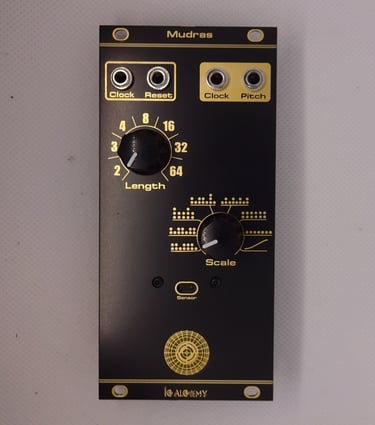
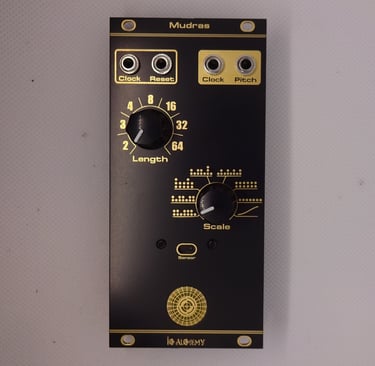
A LIDAR sensor — light detection and ranging, time-of-flight distance sensing — is the antithesis of a screen. It doesn't reflect light back at you. It sends infrared light down at a hand moving above it and measures the time for the reflection to return. From that timing data, it calculates distance with millimeter precision. It does this 60 times per second. It tracks one hand. It reports nothing but position.
That simplicity is the whole point.
When you move your hand above a Mudras instrument, you're not entering coordinates. You're not choosing from a menu. You're not waiting for the interface to interpret your intention. The sensor reads your hand position in real time — up to 60 Hz — and the sequencer captures what you just played. A melody is born from motion, not notation.
We designed the LIDAR sensor in Mudras to read hand position across a range of 700 millimeters with 1 millimeter resolution. That's not precision for precision's sake. It's precision because a musician's hand moves through space with that level of nuance. The rising gesture that subtly pulls pitch upward. The subtle wave that adds expression. The fast flourish that requires the instrument to capture 60 notes per second. A screen-based sequencer would miss all of it.
The instrument doesn't simplify your hand. It listens to your hand's native language and preserves what you intended to play.
Get Lost in the Music, Not the Interface
This is why we exist.
We build instruments where the path from impulse to sound is so direct that you forget you're thinking about control. You think about phrasing. You think about timbre. You think about what comes next. You do not think about the interface.
Mudras Eurorack brought this to the modular community — a module that reads gesture instead of step input. Mudras Standalone freed it from the rack, putting the same gesture engine on a desk in a hand-finished wooden enclosure, powered over USB-C. Mudras Synth Sequencer added a complete DSP synthesis voice underneath the gesture control — no patch cables to another synth, no computer required. Just your hand, the sensor, and the sound already built in.
Our approach has always been the same: shorter distance between your intention and the note. Fewer things to learn before you can make music. More room to focus on what you're actually creating.
Complexity doesn't have to be piled into the interface. Complexity can live in the engine. Deep harmonic control can exist within a system that takes 30 seconds to pick up and play. The richest synthesis tools are the ones you never see — they're just the sound that comes back.
The Ritual Ported
There's a reason we call the moment you move your hand and hear the response a ritual. Ritual is the word for actions that carry meaning beyond their mechanics. When you hum a melody, you're not computing pitches. You're breathing intention into silence. When you raise your hand above a Mudras instrument, you're doing the same thing. The sensor captures it. The sequencer remembers it. The gesture becomes voltage, becomes sound.
We build small batches of real instruments, assembled by hand, in a workshop where someone plays with them before they ship. We keep production runs small not because we're constrained, but because we believe something irreplaceable happens when a single person decides this instrument is ready.
The hand knows before the mind does. And when you build an instrument that listens to the hand without demanding translation, the mind gets to focus on the one thing it should: the music itself.